
Back in 2019, we wrote about chatbots and voice search as the “revolution” coming to digital marketing. Reading that post in 2026 feels like reading a postcard from another planet. The revolution did arrive — it just looked nothing like we expected. Generative AI didn’t merely add a new channel to the marketing mix; it rewrote the rules of every existing one. Search results answer questions before anyone clicks. Content is produced at machine speed. And the classic playbook of “rank, get the click, convert” is being replaced by something stranger and more interesting. Here’s our honest look at how digital marketing actually changed — and what still works in 2026.
In this guide
- AI-generated content changed the economics of publishing
- AI Overviews and the zero-click reality
- The rise of AEO and GEO: optimizing for answers, not rankings
- The third-party cookie saga finally ended (with a shrug)
- Short-form video became the default content format
- From automation to autonomy: AI agents run campaigns now
- What actually stays the same
AI-generated content changed the economics of publishing
The single biggest shift since 2019 is that content is no longer scarce. When anyone can generate a thousand passable blog posts in an afternoon, “publish more content” stops being a strategy. The web has been flooded with AI-written material, and both readers and search engines have adapted by raising the bar for what earns attention.
Google’s response started with the helpful content update in August 2022, which explicitly rewarded “content by people, for people” and demoted material written primarily to game rankings. That philosophy now runs through everything Google does. The practical takeaway for us as marketers: AI is a fantastic drafting and research assistant, but differentiation now comes from the things AI can’t fake — original data, first-hand experience, real opinions, and genuine expertise.
AI Overviews and the zero-click reality
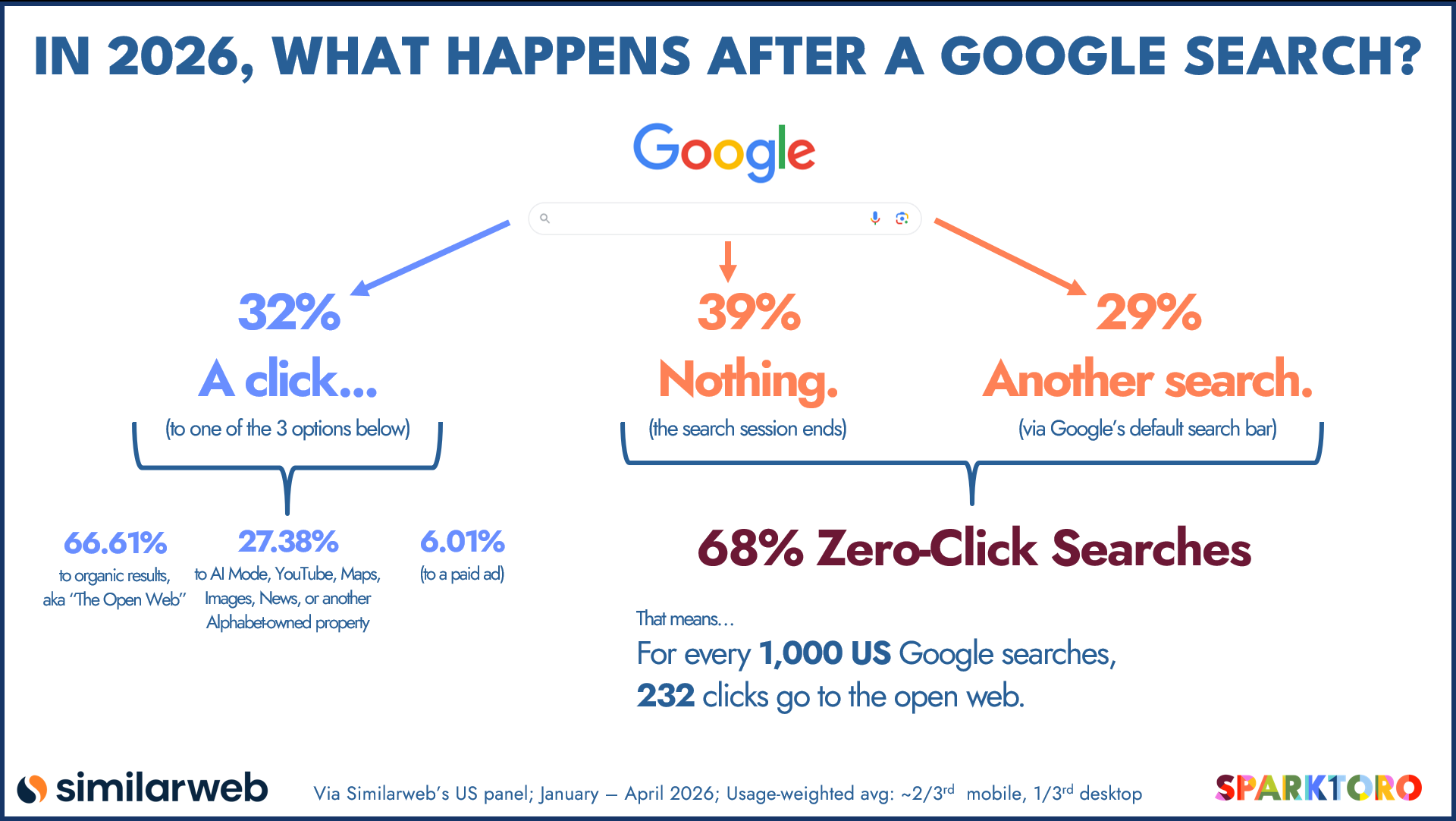
Nothing has reshaped search marketing more than Google answering questions directly on the results page. AI Overviews launched to all US users in May 2024, and by 2026 they appear on a large share of informational queries — with studies showing clicks to websites drop sharply when an AI answer is present.
The numbers are sobering. According to SparkToro’s 2026 clickstream research with Similarweb, less than one-third of Google searches now result in a click to the open web — roughly 68% of searches end without a click at all. Search Engine Land’s coverage of the study notes this is a meaningful jump from the ~58–60% zero-click rates of just a couple of years earlier.
Does that mean SEO is dead? No — Google still sends more traffic to the web than every other referrer combined. But it does mean we have to measure success differently: impressions and brand visibility inside AI answers matter now, not just blue-link clicks.
The rise of AEO and GEO: optimizing for answers, not rankings
Out of the zero-click squeeze came a new discipline — call it answer engine optimization (AEO) or generative engine optimization (GEO). The goal is no longer just to rank #1; it’s to be the source that ChatGPT, Gemini, Perplexity, and AI Overviews cite when they answer a question.
HubSpot’s 2026 AEO research found that a large majority of consumers now plan to use AI assistants for more of their shopping and research, and that ChatGPT alone drives the overwhelming share of AI-referral traffic to websites. The tactics that work look familiar — clear answers near the top of the page, strong structure, schema markup, digital PR that gets your brand mentioned on sources AI models trust — but the mindset is different: you’re optimizing to be quoted, not just clicked.
The third-party cookie saga finally ended (with a shrug)
For half a decade, marketers braced for the death of third-party cookies in Chrome. Then, in April 2025, Google simply… called it off. In an official Privacy Sandbox update, Google announced it would keep the current approach to third-party cookies in Chrome rather than roll out a new deprecation prompt, and later retired most of the Privacy Sandbox ad APIs.
Ironically, the years of panic did lasting good. The industry built first-party data muscle it never had before: newsletters, loyalty programs, logged-in experiences, and consent-based CRM data are now the backbone of serious marketing programs. Cookies survived, but the brands that invested in owned audiences came out far stronger — and with AI assistants increasingly sitting between brands and customers, that direct relationship is worth more than ever.
Short-form video became the default content format
In 2019 we talked about “video marketing” as one tactic among many. In 2026, short-form video is simply where attention lives. TikTok, Reels, and YouTube Shorts turned sub-60-second video into the dominant discovery format for entire generations, and Sprout Social’s 2026 video statistics roundup shows the vast majority of businesses now use video as a marketing tool, with a growing share of marketers using AI tools to script, edit, and even generate video.
Social platforms have also become search engines in their own right — younger users routinely search TikTok and Instagram before Google. If your brand isn’t discoverable in short video, you’re invisible to a meaningful slice of your market.
From automation to autonomy: AI agents run campaigns now
The last piece of the revolution is the newest: AI agents. Where 2019–era “marketing automation” meant drip emails and if-this-then-that rules, 2026’s agents can plan, execute, and optimize across channels — drafting creative variations, reallocating ad budgets, personalizing landing pages, and reporting back in plain language. Google, Meta, and the major CRM platforms have all shipped agentic campaign tools, and enterprise adoption has climbed steeply year over year.
The human role shifts up the stack: strategy, brand judgment, creative direction, and the taste to know when the machine’s output is mediocre. The marketers thriving in 2026 aren’t the ones doing the most manual work — they’re the ones directing the best systems.
What actually stays the same
Strip away the acronyms and the fundamentals are untouched: understand your audience, earn trust, be genuinely useful, and show up where people actually spend time. The channels changed, the interfaces changed, and the middlemen got smarter — but marketing is still about being the answer someone is looking for.
The best place to start is understanding how today’s search results actually look — because the SERP of 2026 is a very different animal from the ten blue links of 2019. We’ve broken down every result type in our complete guide to SERP features — it’s the perfect companion to this post.